Browse Items (18 total)
- Collection: Lens Room Collection
Sort by:
Vent Ball with Spire
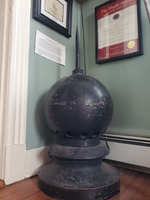
This cast iron vent ball is typical of the standard vent balls used on Lighthouses. The purpose of the vent ball was to allow circulation of air up through the light tower through the lantern room and out through the bottom of the vent ball. A series…
Red Marine Lantern
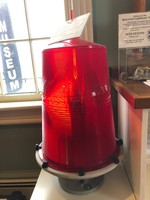
This "blinking Light" is one of the biggest "Single Piece Acrylic Fresnel Optic".
Manufactured by Tideland Signal Co, this type of light is often used in lighthouses, beacons, platforms, and channel markers as it is able to produce a stronger light…
Quick Red Flashing Navigation Light
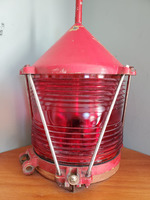
This "Quick Red Flashing" navigation light was donated to the museum by Ronald Bugenski MM2, former Assistant Lighthouse Keeper here at Beavertail from 1962 to 1965.
Lighthouse Models in Display Case
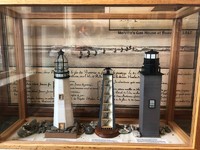
These models represent the Lighthouse structures that have stood at Beavertail over the years
The model of the first lighthouse was constructed by Varoujan Karentz in 2020.
The maker of the second Lighthouse model is unknown.
The third model,…
Gaslight Wall Panel
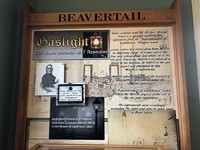
Wall Panel depicting the invention and history of gas lighting in Newport, RI, and at Beavertail Lighthouse.
Funck-Heap Lamp
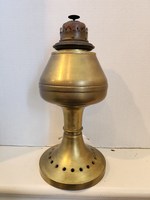
The Funck-Heap lamp, introduced in 1892, became the standard lamp used with every 4th order Fresnel Lens in America. A Lamp such as this one probably provided the light source for the Fresnel lens on display in the center of this room before it was…
Fresnel Lens Wall Exhibit
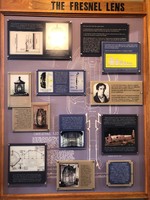
This wall panel provides the history of the Fresnel lens and its inventor Agustin Jean Fresnel.
Fresnel Lens
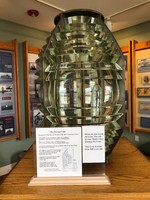
The lens on display in the center of this room is a fourth-order lens that was in the tower at Beavertail until it was replaced in 1991 by a rotating beacon.
The lens can be open to allow visitors to see inside.
Touching the glass prisms is…
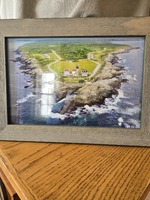
Buoy Lamp and Solar Lamp Charger
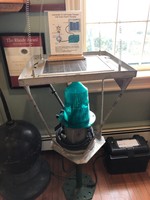
This "12 Volt Lamp Charger" is used as a solar charger for "failed" lamps
The wire springs at each corner of the solar panels keep the sea birds from landing on the solar panels and defecating, thereby limiting the solar charging of the…
Bristol Coastguard Aid to Navigation Plaque
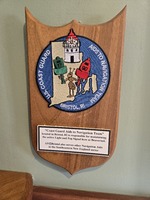
Wooden Plaque reading:"Coast Guard Aids to Navigation Team" located in Bristol, RI is responsible for maintaining the Active Light and Fog Signal here at Beavertail.ANT Bristol also serves other Navigation Aids in the Southeastern New England Sector.
5 Gallon Oil Container
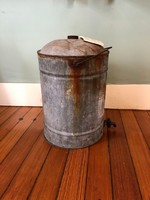
This oil can was used to carry the whale oil up to the top of the tower to keep the light lit. Visitors are invited to try and lift the can and imagine carrying that can of oil up the 49 steps.
1749 Foundation Stone
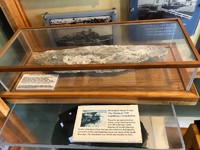
This is a stone from the original foundation of the 1st Lighthouse, built in 1749. The erosion caused by the Great Hurricane of 1938 exposed the foundation and in 2012 it was restored to its original state. The foundation can be viewed in front of…
1000 Watt Bulb & Automatic Bulb Changer
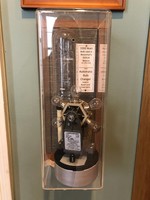
1000 Watt Bulb - used in Beavertail's DCB-24 Beacon from 1991 until 2018.Automatic bulb changer. - This was most commonly used in buoys and fixed lights. This mechanism sensed a burned-out bulb and automatically replaced it with a new one.
"The Golden Age" Wall Exhibit
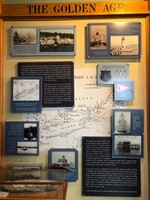
This storyboard summarizes the building and expansion of lighthouses in Rhode Island and Narragansett Bay waters in the 18th and 19th century
"The Decline" Wall Exhibit
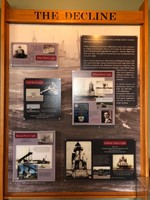
This storyboard tells the story of several lighthouses that no longer exist due to weather events, deterioration over time, or by being intentionally destroyed. Included are Sabin Point, Gull Rock Light, Whale Rock Light, Bristol Ferry Light, and…
"Preservation" Wall Exhibit
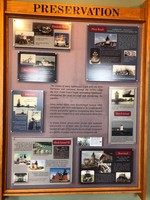
This storyboard highlights preservation efforts that have rescued some local lighthouses. Included are Pomham Rocks, Plum Beach, Rose Island, Sokonnet, Dutch Island, Block Island, and Beavertail.
"Early Lights" Wall Exhibit
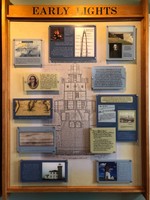
This storyboard presents stories of the earliest lighthouses in Rhode Island and Narragansett Bay.